.png?width=2000&height=500&name=Black%20Gradient%20Minimalist%20Corporate%20Business%20Personal%20Profile%20New%20LinkedIn%20Banner%20(1).png "Black Gradient Minimalist Corporate Business Personal Profile New LinkedIn Banner (1)")
.png?height=200&name=Contracts-As-Code_2%20(1).png)
A new way to think about AI contract management by turning complex healthcare agreements into...
Healthcare contracts are foundational to how payers and providers work together, yet they remain some of the most complex documents in the industry; long, complicated, and scattered across multiple systems.
A single healthcare provider contract can span hundreds of pages, and often includes multiple amendments, nested tables, and rate sheets or exhibits that rarely follow a consistent format. This lack of uniformity makes healthcare contract management slow, manual, and prone to interpretation errors.
As payers face rising pressure to improve their accuracy and compliance, many are turning to generic LLMs or basic automation tools. But healthcare contract intelligence demands more than text extraction. It requires a system that understands how contractual meaning is created through structure, context, and cross-referencing.
This blog breaks down why traditional approaches fall short and how MCheck® ContractsAI by HiLabs, a purpose-built healthcare contract management solution, delivers accuracy and trust at scale.
Why Healthcare Contracts Are Uniquely Complex
Healthcare contracts contain far more variation and structural complexity than other commercial agreements. Payers often have their own formats for clauses, reimbursement terms, and rate exhibits that are inconsistent over time.
A single provider contract may include a base contract, multiple amendments, regulatory riders, supplemental schedules, and rate sheets that are referenced throughout the document but not always placed in consistent locations. When these components are scattered, teams must manually trace how different terms connect across multiple files and sections.
This fragmentation makes it difficult for teams to trace how one clause affects another or how a rate sheet aligns with a specific line of business. Even small shifts in language, table layout, or section numbering can alter interpretation.
These issues contribute to significant operational risk, including:
- claim payment errors
- provider abrasion
- compliance exposure
It’s not uncommon for teams to spend hours navigating these documents, especially when even a small oversight can lead to expensive errors. To manage risk, healthcare provider contracts demand precise reading, accurate linkage of related documents, and a clear understanding of contractual intent—conditions that are hard to meet using manual review or generic LLMs.
The Limitations of Using Generic LLMs for Healthcare Contract Management
General-use LLMs were never designed to interpret healthcare contract structure. When asked to work with such documents, they often convert documents into plain text, losing the formatting, hierarchy, visual cues, and relationships between sections—essential information that contract administrators rely on.
When contracts are flattened this way, critical context are lost as to which rate applies to which clause, how an amendment modifies an earlier section, or whether a term affects a specific line of business. This loss of structure leads to recurring errors, such as:
- Amendments appearing as disconnected text
- Missing or overlooked rate sheets
- Vague, incomplete, or hallucinated answers
These failures do not occur because the model is weak; they occur because the contract’s visual and logical structure is lost during ingestion. Without that structure, LLMs cannot reliably interpret reimbursement requirements or align the correct rates, clauses, and exceptions with confidence.
Healthcare contract management requires a level of precision that generic LLMs are simply not built to provide. That’s exactly where ContractsAI comes in.
Introducing ContractsAI: Purpose-Built to Understand Healthcare Contracts Like a Human, at Scale
MCheck® ContractsAI is a healthcare contract intelligence platform built specifically to interpret the structure, context, and intent of provider contracts. Unlike generic LLMs, ContractsAI preserves the layout, relationships, and document lineage that determine how contract terms should be understood.
The HiLabs solution uses a purpose-built pipeline designed around how real healthcare contracts are written and how payers interpret reimbursement rules—by combining vision intelligence, semantic structuring, and GraphRAG retrieval. By maintaining the visual and logical structure of each agreement, ContractsAI delivers highly accurate and reliable responses that reflect the original source documents.
How ContractsAI Transforms Healthcare Contracts into Accurate, Trusted Intelligence
The following capabilities demonstrate how ContractsAI interprets healthcare contracts while preserving structure and context:
Vision Models That Read the Document, Not Just the Text
ContractsAI uses multi-modal vision models that detect the elements that matter in a contract:
- Headers, sub-headers, and footers
- Clause boundaries
- Tables
- Rate sheets, addendums, and supplemental exhibits
This approach preserves the structural cues of the agreement, which is essential for correct interpretation.
Context Binding Across All Related Documents
A complete contract is rarely a single file. It may include a base agreement, several amendments, regulatory riders, and multiple rate sheets.
ContractsAI binds these pieces together. The model determines which rate sheet belongs to which clause, which amendment modifies which section, and which line of business a specific rate applies to. Context is never lost, even if a contract spans dozens of files.
Semantic Chunking That Mirrors How Contracts Are Written
Instead of splitting text by size or token count, ContractsAI creates intelligent chunks that reflect logical boundaries.
Each chunk carries metadata, such as:
- Page number
- Section lineage
- Line of business
- Provider type
- TIN
- Clause category and clause subtype
This makes retrieval accurate and auditable. When a user asks a question, the model responds with the exact clause, table cell, or rate with its source lineage.
This approach allows ContractsAI to support accurate interpretation across base agreements, amendments, regulatory attachments, and rate sheets—providing the foundation for automation, pricing configuration, and reliable contract analysis at scale.
A Knowledge Graph That Serves as the Contract’s Digital Twin
All extracted content is mapped into a structured knowledge graph that captures:
- Contract clauses
- Provider classifications
- Reimbursement terms and rate definitions
- Conditions and exceptions
- Cross-references across documents
The graph creates a digital version of the contract that retains meaning and relationships. This is very different from traditional OCR or unstructured LLM output.
GraphRAG for Accurate, Complete, Evidence-Linked Answers
GraphRAG is an advanced retrieval-augmented generation (RAG) technique that combines structural context from the knowledge graph, semantic search, and LLM reasoning to provide context-rich responses.
Users receive answers that are accurate, complete, and always tied to the original PDF. This builds trust during negotiation, pricing configuration, regulatory audits, and internal reviews.
Real-World Impact: What Healthcare Organizations Gain with ContractsAI
ContractsAI by HiLabs supports more reliable interpretation of healthcare provider contracts by preserving structure, context, and document lineage. By maintaining these elements, the platform improves contract accuracy across interconnected agreements and rate sheets.
This structured understanding also helps organizations manage reimbursement terms more consistently. Accurate linkage between clauses and rate sheets supports reimbursement efficiency without requiring teams to manually reconcile scattered contract components.
ContractsAI outputs integrate naturally into healthcare contract lifecycle management (CLM) workflows. Because the platform retains contractual intent, its insights align with downstream processes such as pricing configuration, negotiation review, and audit readiness.
Based on the capabilities outlined earlier, healthcare organizations gain the ability to:
- Interpret contract clauses with greater consistency
- Validate rates and reimbursement terms using source-linked context
- Support pricing configuration with accurate clause and rate extraction
- Strengthen negotiation preparation
- Benchmark rate structures
- Prepare for regulatory audits and financial reviews
Example Workflow: From Raw Contract to Structured Intelligence
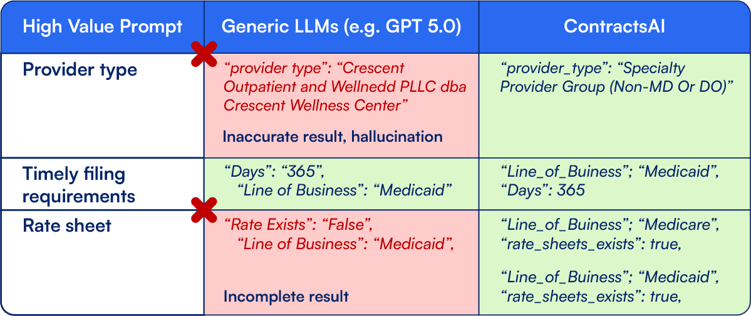
ContractsAI’s structured approach to CLM becomes clear when applied to a real contract scenario. The following example illustrates how the solution interprets documents compared to a generic LLM, using the same inputs under the same conditions.
|
|
Generic LLMs |
ContractsAI |
Provider Type Extraction |
❌ Returned the provider’s name instead of the provider type. |
✔ Correctly extracted Specialty Provider Group (Non MD or DO) by understanding the table hierarchy and clause structure. |
Rate Sheet Detection and Linking |
❌ Missed the Medicaid rate sheet |
✔ Detected both Medicare and Medicaid rate sheets |
This example demonstrates how retaining document format, lineage, and contextual relationships enables reliable interpretation.
How ContractsAI Fits into Your Existing Contract Workflow
ContractsAI supports existing contract workflows by providing context-aware automation that complements the analysis already performed by payer teams. Because the solution retains contractual intent and document lineage, its outputs flow naturally into downstream tasks that rely on accurate clause interpretation and rate validation.
Teams can reference clauses, rate details, and contextual extracted by ContractsAI during any phase of the contract lifecycle, including:
- Pricing configuration
- Negotiation preparation
- Rate benchmarking
- Financial simulations
- Compliance and audit readiness
These activities reflect how organizations already use structured contract intelligence, and the same information supports review cycles within healthcare contract lifecycle management (CLM) processes.
By preserving structure and relationships across base agreements, amendments, and rate sheets, ContractsAI provides a consistent information layer that supports decisions throughout the contracting lifecycle. This helps reduce the manual effort needed to trace contractual changes across files, while supporting the review activities teams already perform as a part of established workflows.
Conclusion: Turning Healthcare Contracts into Trusted Intelligence
Healthcare contracts are complex, fragmented, and heavily dependent on structure for accurate interpretation. ContractsAI supports a more consistent understanding of these agreements by preserving document hierarchy, clause relationships, and contextual linkages across all related files. By presenting contract terms in an organized format, the platform helps teams review contract information more consistently.
This structured view aligns with the needs of payer teams engaged in activities such as pricing review, negotiation preparation, rate validation, and audit support. Rather than reconciling scattered documents, teams can reference contract information that remains tied to the original source materials.
As contracting requirements continue to evolve, the ability to convert unstructured agreements into dependable, context-aware intelligence becomes increasingly important. ContractsAI provides a foundation for this shift by offering a structured approach to interpreting healthcare contracts without altering existing workflows.
This is not simply AI layered on top of PDFs. It is a new way of understanding and reviewing contracts that supports faster operations, smarter decisions, and scalable contracting performance across the enterprise.
At HiLabs, we are dedicated to solving the most complex challenges in healthcare data. To discover how ContractsAI can support your contract review cycles, book a demo today.